DDoS Protection
State of DDoS Attacks India 2026 — 1.7 Tbps Mitigated, Zero Downtime
Published 10 July 2026 · Updated 9 July 2026 · GigaNodes Team
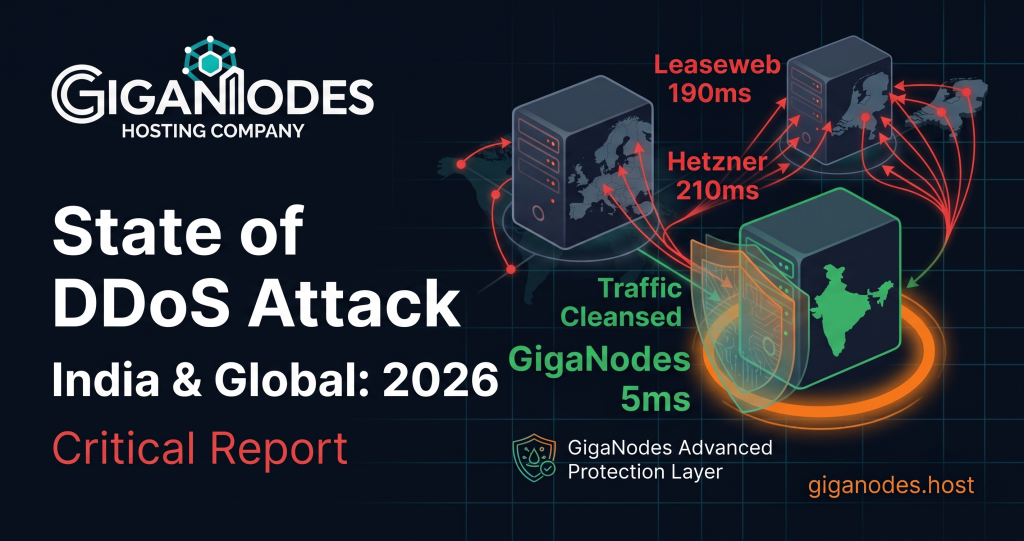
State of DDoS Attacks India 2026 — 1.7 Tbps Mitigated, Zero Downtime
·
July 9, 2026
·
12 min read
DDoS attacks on Indian hosting infrastructure are increasing in size and frequency in 2026. GigaNodes recorded and mitigated a 1.7 Tbps UDP flood in May 2026 — zero customer downtime — using Cloudflare Magic Transit. Most Indian hosting providers still use blackholing, which takes servers offline during attacks. Cloudflare Magic Transit is the difference between a server that stays online and one that goes dark.
In May 2026, someone targeted one of our customer’s IP addresses with a 1.7 Tbps UDP flood. 184.38 million packets per second. The attack lasted several minutes. Our customer’s server stayed online throughout. No players disconnected. No trades were interrupted. No support tickets were raised.
We found out about it the next morning from the Cloudflare Magic Transit dashboard.
This is what the state of DDoS attacks in India looks like in 2026 — and more importantly, what the gap looks like between providers that are actually equipped to handle them and those that are not.
The 1.7 Tbps Attack — What Actually Happened
On May 30, 2026 at 13:17 UTC, Cloudflare’s systems detected a volumetric DDoS attack against IP prefix 2.27.157.10/32 — a client’s dedicated IP pool hosted on GigaNodes infrastructure under Advika Datacenters’ ASN (AS135682). The attack type was UDP Flood at 1.7 Tbps peak, 184.38 million packets per second.
2026-05-30T13:17:02Z UTC
UDP Flood
1.7 Tbps / 184.38 Mpps
2.26 TB
2.26 TB (100%)
0 bytes
Zero
The Cloudflare Managed DDoS L3/4 Ruleset detected and blocked the attack automatically. No human intervention was required. The entire 2.26 TB of attack traffic was absorbed by Cloudflare’s global network — none of it reached Yotta DC Noida.
The target IP is hosted on Advika Datacenters’ ASN (AS135682) — publicly verifiable at bgp.tools/prefix/2.27.157.0/24. The BGP routing through Cloudflare Magic Transit is also publicly verifiable at bgp.tools/prefix/87.76.191.0/24.
DDoS Attacks on Indian Infrastructure — What Changed in 2026
DDoS attacks against Indian hosting infrastructure have been growing in both volume and frequency. Several factors are driving this.
Attack Volumes Are Getting Larger
A 1 Tbps attack was considered exceptional two years ago. In 2026, volumetric attacks above 500 Gbps are becoming routine for targeted infrastructure. The cost of launching large DDoS attacks has dropped significantly — botnet-for-hire services make terabit-scale attacks accessible to anyone with a few hundred dollars and a grudge.
For Indian hosting providers without network-layer protection, this trajectory is a serious problem. Blackholing can handle most attacks by taking the server offline — but it cannot protect a server that needs to stay online.
Game Servers Are Primary Targets
Indian game servers — Minecraft, FiveM, ARK, Rust, Valheim — are among the most frequently targeted by DDoS attacks. The economics make sense from an attacker’s perspective: attacks are cheap, the impact is immediate, players are directly affected, and most Indian game server hosting providers use blackholing.
A common pattern we see on GigaNodes: a new Minecraft server in India gets popular, attracts 200-300 players, and then gets targeted by a rival server operator. UDP floods are the preferred attack type because game servers communicate via UDP and basic filters cannot distinguish attack traffic from legitimate player traffic without deep inspection.
With Cloudflare Magic Transit, UDP flood attacks are scrubbed at the routing layer. The server never sees the attack. Players stay connected. The game keeps running.
Forex and Trading Bots Are High-Value Targets
MT4 and MT5 algo trading bots running on Indian VPS servers have become valuable DDoS targets. Taking a trading bot offline during market hours can cause direct financial losses — missed signals, open positions that cannot be managed, orders that cannot execute. Targeted attacks during high-volatility periods are not uncommon.
Standard blackholing is unacceptable for this use case. A trading server that goes offline during an attack is a server that costs its operator real money. Cloudflare Magic Transit keeps Forex VPS India servers online regardless of attack volume.
How Indian Hosting Providers Handle DDoS in 2026
The DDoS protection landscape among Indian hosting providers is not uniform. Here is an honest breakdown of what different approaches actually mean during an attack.
| Provider | Protection Type | During Attack | UDP Protection |
|---|---|---|---|
| GigaNodes | Cloudflare Magic Transit | ✅ Server stays online | ✅ Full |
| MilesWeb | Blackholing | ❌ Server offline | ❌ None |
| HostingRaja | Blackholing | ❌ Server offline | ❌ None |
| E2E Networks | Basic filtering | ⚠️ Partial | ⚠️ Limited |
| DigitalOcean India | Basic filtering | ⚠️ Partial | ⚠️ Limited |
| OVHcloud India | OVH VAC | ⚠️ Partial mitigation | ✅ Some UDP |
| Contabo | None | ❌ Server offline | ❌ None |
Blackholing vs Cloudflare Magic Transit — The Real Difference
The term “DDoS protection” covers a wide range of capabilities. Most Indian hosting providers market blackholing as DDoS protection. It is not protection — it is a response to an attack that trades your server’s availability for network stability.
What Blackholing Actually Does
When an attack exceeds the provider’s network threshold, the upstream router null-routes the target IP. All traffic to that IP — attack traffic AND legitimate traffic — is dropped at the routing level. The server is effectively disconnected from the internet until the attack stops and the provider restores routing.
For a game server with 300 players, this means 300 disconnections. For a trading bot, this means your positions are unmanaged. For an ecommerce site, this means no orders are processed. The attacker achieved exactly what they wanted.
What Cloudflare Magic Transit Does
With Cloudflare Magic Transit, GigaNodes IP prefixes are announced via BGP to Cloudflare’s global network. All traffic — before it can reach Yotta DC Noida — enters Cloudflare’s backbone at the nearest point of presence globally. Cloudflare’s network inspects traffic at layers 3 and 4. Attack packets are dropped. Legitimate packets are encapsulated and forwarded via GRE tunnel to the destination server.
The server never sees the attack. Cloudflare’s network absorbs it. With a global capacity exceeding 100 Tbps across 310+ cities, even a 1.7 Tbps attack is a fraction of available capacity.
1.7 Tbps UDP flood launched from botnet globally — 184 million packets per second
All traffic enters Cloudflare’s nearest PoP via BGP before reaching India
Cloudflare Managed DDoS L3/4 Ruleset identifies and drops all attack packets
2.26 TB of attack traffic dropped. 0 bytes reach Yotta DC Noida. Server online throughout.
Why GigaNodes Is the First Indian Provider with Magic Transit
Cloudflare Magic Transit is not a product you can sign up for on Cloudflare’s website. It requires BGP-level integration between the hosting provider’s network and Cloudflare. This means the upstream network operator — the company that owns the ASN and manages BGP routing — has to work directly with Cloudflare at the infrastructure level.
GigaNodes made this possible through a partnership with Advika Datacenters Private Limited (AS135682) at Yotta DC Noida. Advika manages the BGP integration with Cloudflare. GigaNodes IP prefixes are announced through AS135682 into Cloudflare’s network.
No other Indian hosting provider has done this. The reasons are practical — Magic Transit requires a serious infrastructure partner willing to implement BGP-level changes, and it requires commitment from both sides. Most Indian providers have neither the infrastructure relationships nor the willingness to absorb the complexity of this deployment.
The result for GigaNodes customers: enterprise-grade DDoS protection on every plan, from ₹440/mo VPS to ₹44,999/mo dedicated servers. The same protection Fortune 500 companies pay for — included free.
The Bonus Effect — Better Routing for Indian Users
Deploying Magic Transit had an unexpected side effect. Because all traffic to GigaNodes servers now passes through Cloudflare’s backbone first, we benefit from Cloudflare’s direct peering relationships with Jio, Airtel, and BSNL.
Traffic from a Jio user in Delhi to a GigaNodes server in Noida now routes through Cloudflare’s direct peering with Jio — fewer hops, lower latency, more consistent routing compared to public internet paths. This improvement affects all traffic, not just during attacks.
We did not deploy Magic Transit for the routing improvement. It was a side effect we did not anticipate.
Cloudflare Magic Transit included free on every plan · 100 Tbps+ Cloudflare network · Zero downtime during 1.7 Tbps attack · First Indian hosting company to deploy Magic Transit · VPS from ₹440/mo →
What This Means for Your Hosting Decision
If you are running a game server, a trading bot, a SaaS API, or any production workload in India — the question of DDoS protection is not theoretical. Attacks happen. The question is what your hosting provider does when they happen.
Blackholing means your server goes offline. Your users disconnect. Your revenue stops. The attacker wins. This is the reality for most Indian hosting customers today.
Cloudflare Magic Transit means your server stays online. Your users notice nothing. The attacker’s investment is wasted. This is what GigaNodes VPS India provides from ₹440/mo.
The state of DDoS attacks India in 2026 is: attacks are getting bigger, cheaper to launch, and more targeted. The state of DDoS protection in India in 2026 is: one provider has network-layer protection. The rest have blackholing.
Frequently Asked Questions
Related guides
Get DDoS Protected Hosting in India
Cloudflare Magic Transit · AMD EPYC 7C13 · Yotta DC Noida · UPI accepted · GST invoice
⭐ 4.9/5 from 500+ reviews · Server stays online during attacks · From ₹440/mo